KarenVintage
Launch promo ends in00:00:00
KarenVintage, honestly priced

Most people put it back on the shelf, go home, look it up — and drive straight back.

The working manual for the secondhand aisle: what a thing is actually worth, how to tell the fake from the real, and where it sells for the most — from someone who has done it for a living.

Instant download · Yours forever
90Chapters
7Parts
145Illustrated pages
Karen in her kitchen, surrounded by vintage glass and enamelware

“This is a working manual, not a coffee table book.”

Karen — Before You Begin
I · The Manual

Forty minutes before closing, and nobody to ask.

That is the moment this book was written for. You are holding a bowl. It is four dollars. It is either four dollars of nothing or the best find of your month, and the only difference is what you know about the seam on the bottom of it.

I have been buying and selling other people's old things for a living for a long time. Everything I learned came one of two ways: slowly, or expensively. I have bought fakes. I have ruined a piece of furniture with a can of stripper. I have shipped a punchbowl in a grocery bag full of newspaper and learned what a claim form looks like.

“What is in here is what I would tell you if we were standing in a thrift store aisle together.”

So this is not a price guide. Price guides go stale the day they are printed, and half of them list what somebody hoped an item was worth rather than what one actually sold for. Where I give you dollar figures, they are ranges I have watched things move at — and I always show you how to check the number yourself. Learning to look up a real sold price is worth more than any list I could hand you.

It is not a decorating book either. This one is about the money, the knowledge, and the hunt. Though if you only ever want to furnish your own house with good old things, you will still get your money's worth — knowing what is good and what it should cost is the same skill either way.

Every chapter is short enough to read standing up. Every chapter ends with a box called The Limits, where I tell you exactly where the advice stops working. I have not sanded the corners off any of it.

The Secondhand Goldmine, First Edition, by Karen
First Edition · MMXXVI · 145 pages
II · The Difference

Browsing is a hobby. Scanning is a skill.

Most people work a secondhand store the same way they work a bookstore — slowly, item by item, hoping something jumps out. Here is what changes once you know what you are looking at.

The way most people shop

  • Reads every item on the shelf, leaves after two hours with nothing
  • Buys because a thing is old, then finds out old and valuable are two different things
  • Guesses at value from asking prices on listings that never sold
  • Pays collector money for something only a decorator wants
  • Misses the reproduction until the buyer points it out
  • Scrubs the piece bright and wipes out half its value
  • Lists it with the word "vintage" in the title and waits
  • Ships it, then learns what the shipping actually cost

The way this manual teaches

  • Works a whole store in twenty minutes on a fixed route, housewares first
  • Scans for four signals: unusual color, unusual weight, hand finishing, wrong-decade shapes
  • Checks the real sold price — the only number that tells the truth
  • Names the buyer out loud before paying: collector, decorator, or user
  • Knows the reproduction tells that work on almost anything
  • Follows the rule of least intervention, and knows when to keep hands off
  • Writes the title the way the buyer actually searches
  • Prices with the shipping weight already in the number
III · What's Inside

Seven parts. Ninety chapters. Each one answers a question you have had in an aisle.

Part One

How the Market Really Works

Chapters 01–13
  • What vintage actually means, and why the word costs you money
  • The three kinds of buyers you are selling to
  • The condition ladder: mint to parts only
  • Sell-through rate: the only number that tells you the truth
  • The mistakes that cost new pickers their first thousand dollars
Part Two

Where the Good Stuff Hides

Chapters 14–26
  • Thrift stores: how to work a store in twenty minutes
  • The thrift calendar: restock days, tag sales, and timing
  • Estate sales: the first hour and the last hour
  • Auctions: live, absentee, and the buyer's premium trap
  • Building the network that calls you first
Part Three

Reading the Object

Chapters 27–39
  • The sixty-second inspection every piece gets
  • Maker's marks: where to look on every kind of object
  • Glass: seams, pontils, and the feel of old glass
  • Metals: telling silver, silverplate, and pot metal apart
  • Smell, weight, and sound: the senses nobody teaches
Part Four

The Categories That Pay

Chapters 40–55
  • Cast iron: the smooth pans and the names that matter
  • Depression glass, elegant glass, and milk glass
  • Sterling silver and flatware by the ounce
  • Vintage clothing, denim, and the collector market
  • Advertising, signs, tins, cameras, tools, and holiday vintage
Part Five

Fakes, Repros, and Marriages

Chapters 56–66
  • The reproduction tells that work on almost anything
  • Fake marks and forged signatures
  • Fake advertising signs and the rust that lies
  • Marriages, frankenpieces, and replaced parts
  • When you get burned: recovering money and reputation
Part Six

Cleaning, Repair, and What Not to Touch

Chapters 67–77
  • The rule of least intervention
  • Removing stickers, tape, and old glue
  • Odors: smoke, mildew, and basement smell
  • Cleaning metal without killing the value
  • Electrical items: testing and rewiring safely
Part Seven

Pricing, Selling, and Getting Paid

Chapters 78–90
  • Choosing the right venue for each item
  • Photographs that double your price
  • Titles and descriptions that get found
  • Packing fragile things so they arrive whole
  • Inventory turn: the number that runs the business
In every chapter

The Limits

All 90 chapters
  • Every chapter ends with a box marked The Limits
  • Where the rule stops working, and what to do instead
  • The exceptions that cost people money
  • No chapter is longer than you can read standing up
  • Illustrated throughout — marks, seams, joinery, and tells
Written to be used, not shelved. Read it in whatever order suits you. Skip to the category you already collect. Come back to the sourcing chapters when you get bored of your usual stores.
Instant download · Yours forever
IV · Reader Results

From the people already working the aisles.

★★★★★

“The twenty-minute route changed everything. I used to spend a whole Saturday in one store and come home with junk. Now I do four stores before lunch and I actually know why I am picking something up.”

Placeholder · Reader
★★★★★

“The chapter on cast iron paid for the book eleven times over. I had walked past that pan twice because it was on the bottom shelf with the pot metal.”

Placeholder · Reader
★★★★★

“I nearly scrubbed a silver-plated tray down to the copper. The 'what not to touch' part stopped me the night before. That section alone belongs in every booth in America.”

Placeholder · Reader
Karen
V · About

I am Karen. I buy other people's old things for a living.

My kitchen is the one you see behind me — the stove is a 1950s original, the shelves are full of Pyrex I did not pay much for, and every single piece has a story about where it came from and what the tag said.

I did not learn any of this in a classroom. I learned it in estate sale driveways at seven in the morning, in church basements, at flea market tables where the dealer knew more than I did, and in the back of my car with a flashlight and a phone, looking up a mark before I drove home.

The people who taught me were dealers who had been doing it for thirty years and did not hand out their knowledge for free. It took a long time and a fair amount of money to assemble what is in this book. I wrote it so the next person would not have to buy the lesson twice.

If you have ever put something back on the shelf, gone home, looked it up, and driven straight back — this was written for you.

KarenKaren · Vintage
VI · Get the Book

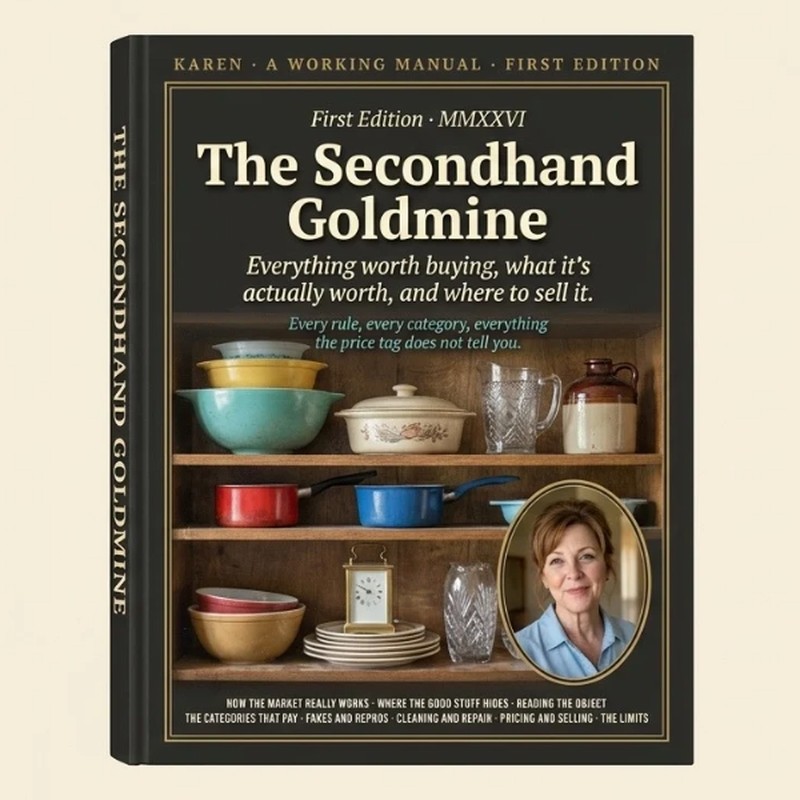
The Secondhand Goldmine

Everything worth buying, what it's actually worth, and where to sell it.

The Secondhand Goldmine

Illustrated First Edition · MMXXVI
  • All 90 chapters across seven parts — market, sourcing, identification, categories, fakes, cleaning, and selling
  • 145 illustrated pages — marks, seams, joinery, and the tells, drawn where a photograph would not help
  • A "Limits" box in every chapter — where the rule stops working and what to do instead
  • The 16 categories that reliably pay, each with what to look for and what it moves at
  • The reproduction chapters — 11 chapters on fakes, forged marks, and frankenpieces
  • Instant PDF download — reads on your phone in the aisle, or on any computer at home
$47$27 USD · One-time · Launch promo
Get the Secondhand Goldmine — $47 $27
Instant download · Yours forever
Visa · Mastercard · Amex · PayPal · Secure checkout by Gumroad
VII · Questions

Before you buy.

Is this a price guide?

No, and on purpose. Price guides go stale the day they are printed, and half of them list what somebody hoped an item was worth rather than what one actually sold for. Where I give dollar figures, they are ranges I have watched items move at — and every time, I show you how to check the current number yourself. Learning to look up a real sold price is worth more than any list I could hand you.

Your videos are free. Why buy the book?

The videos are one object at a time. A bowl, a pan, a mark on the bottom of a plate. They are the fun part, and they will always be free.

The book is the system underneath them: the route through the store, the sixty-second inspection, the three buyers, the condition ladder, the sell-through number, the reproduction tells, and what to do with a piece once you own it. It is what I would have to say across two hundred videos, in order, in one place, searchable, in your pocket in the aisle.

Why only $27?

Because the people I want holding this are the people standing in the aisle on a Tuesday with forty dollars to spend, and pricing it like a course would keep it away from exactly them. It is a digital file — no printing, no warehouse, no shipping — so the price only has to cover the work of writing it. $27 is the launch price, struck from $47.

What format do I actually get?

A PDF, delivered the moment you check out. 145 pages, illustrated, fully bookmarked by chapter. It opens on any phone, tablet, or computer — no app, no account, no subscription. Download it once and it is yours to keep, including on the phone you carry into the store.

I do not want to resell. I just want good old things for my own house.

You will still get your money's worth. Knowing what is good and knowing what it should cost is the same skill whether you sell it or keep it. Parts Three, Five, and Six — reading the object, spotting reproductions, and cleaning without ruining — are exactly the same for a collector as for a dealer. You will just keep the piece at the end.

I am completely new. Is this too advanced?

Part One assumes you know nothing, and it is deliberately the first thing in the book because it is the part most people skip and most people should not. Every chapter follows the same shape and is short enough to read standing up. Start at the front, or skip straight to the category you already collect — it is built to be opened anywhere.

Do the prices in the book work outside the United States?

The dollar ranges and some of the venues are American, because that is the market I work in. The method is not — the condition ladder, the marks, the construction dating, the reproduction tells, and the selling chapters travel anywhere people sell old things to each other. Check your own local sold prices; the book shows you how.

Instant download · Yours forever
Karen
Wait — one thing

Less than one lucky find.

Ninety chapters of what I learned the slow way and the expensive way — for less than most people spend on a single shelf of glass they were not sure about.

Get the Secondhand Goldmine — $47 $27
Instant download · Yours forever
or see what's inside →